


Adriana de González Prada
(1865-1948)

 Biography
Translated by Karen Roman
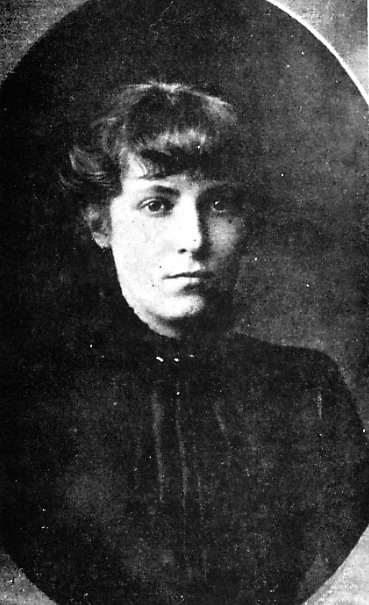
Adriana de González Prada is best known for being the wife of Peruvian intellectual, Manuel González Prada. Her literary legacy centers around Mi Manuel (1947), a text that stands out for its hybrid genre and discursive strategies. Recently, literary critics have revisited this text reevaluating its multifaceted nature and proposing new interpretations that highlight the text’s value thus resurrecting it from obscurity.
Adriana Adelaide Chalumeau de Verneuil Conches was born into an impoverished bourgeois family in Villeroy, France on October 25, 1864. Following the death of her mother, her father, Jules Chalumeau de Verneuil, emigrated to Peru with Adriana and her older brother. The family traveled through England and the United States, reaching Callao on October 16, 1875 aboard the Acapulco steamship. In 1876, Adriana was enrolled in a Catholic school named Colegio de los Sagrados Corazones de Belén, where she became friends with the niece of Peruvian intellectual Manuel González Prada. In 1885, a controversial relationship developed between Adriana and Manuel, as Manuel’s mother Doña Josefa Ulloa, did not approve of the union. The couple could not marry until Ulloa’s death on September 11, 1887. They finally were able to marry in a private ceremony at the Lima parish of San Mateo.
The newlyweds’ home quickly became the meeting place for the Literary Circle, which was founded in 1886. Adriana helped her husband with his intellectual work, transcribing manuscripts and speeches, handling correspondence, and managing his public appearance schedule (Peluffo 199). The couple had three children: Cristina, Manuel, and Alfredo. The first two children did not survive their first year of life and passed away in 1888 and 1889. Alfredo, who was born in Paris on October 16th, 1891, was the only surviving child. Alfredo held diplomatic posts and, like his father, was active in literature and journalism.
In 1891, the couple traveled to Europe, departing from Callao and making stops in Guayaquil, Panama City and Kingston, before finally arriving in Cherbourg, France. They settled in Europe for seven years, living in Paris and traveling through Switzerland, Belgium, and Spain. In 1898, the family returned to Lima, where Manuel Gonzalez Prada continued his literary and political activities. Adriana de González Prada outlived her husband, who died on July 22, 1918, and her son Alfredo, who tragically committed suicide on June 27,1943, by jumping from a skyscraper in New York City.
At the age of 70, decades after her husband’s death, Adriana began writing, Mi Manuel, in New York. The book was completed in 1944 and was published in Lima in 1947. Adriana de González Prada died on September 22, 1948.
Mi Manuel (1947)
Mi Manuel is an extensive book. It is written in the first person and is organized into 43 chapters. The first part (Chapters 1-3) focuses on Adriana’s birth and childhood in France. The second part (Chapters 4-13) recounts her arrival in Lima and the process of adaptation, her studies, her experiences during the war with Chile, the death of her father, her courtship, and then her married life. The third part (Chapters 14-25) narrates the couple’s experiences in Europe and is the only existing record of this key period in Manuel Gonzalez Prada’s life and works (Minardi 58-59). The last 18 chapters focus on the family’s return to Lima and Manuel’s involvement with the country’s intellectual and socio-political circles. The book concludes with her husband’s death on July 22,1918.
For a long time, interest in Adriana Gonzalez Prada centered on her contribution to her husband’s historiography, and thus, Mi Manuel was read as a simple biography. More recent studies have focused on a reinterpretation of her figure and legacy, taking into consideration Adriana’s authorial strategies and the hybrid nature of the volume. The title suggests a male biography, but the text quickly shifts in multiple directions, becoming an autobiography, a memoir with family photos, a travelogue, and a testimony. Undoubtedly, the work is an example of the cultural intervention of a female subject and her relationship with her male counterpart.
At the time of the book’s publication, Manuel Gonzalez Prada had already become an idealized figure for younger generations of intellectuals in Peru. The work is just one piece of an extensive biographical collection about him, but this one allows its author to “have her say in the competition of biographical versions” (Peluffo 186). Adriana de Gonzalez Prada does not seem to have a defined audience in mind, but she does establish her purpose from the beginning in the “Disclaimer” that prefaces the work. First, she states that the book is a tribute to her husband, and had been commissioned by their son Alfredo, the editor of the book. It was also written as a reaction to previously published biographies of Manuel Gonzalez Prada, particularly, Don Manuel (1930) by Luis Alberto Sanchez. Unlike those other texts, Adriana de Gonzalez Prada emphasizes personal and intimate aspects, thus establishing her authority as his biographer. She distanced herself from other impersonal autobiographies by emphasizing the testimonial aspect of her work. In the process, what began as a biography of Manuel Gonzalez Prada gradually changed into a hybrid text that transformed Adriana de Gonzalez Prada into narrator and protagonist. Mi Manuel became a “story of two lives” that subverted the “official story” told in previously published biographies (Tauzin 189). When reading the book, it is important to keep in mind that Mi Manuel is not only the portrait of a famous man in whose shadow the author lived, but also the living document of a woman who sought and found her place within the social and cultural dynamic of Peru at the beginning of the 20th century” (Minardi 63).
Ana Peluffo (2012) places this text within the female autobiographical literary canon, pointing out how it dialogues with Peregrinaciones de una paria (1838) by Flora Tristan. At the same time, she comments on how Adriana de Gonzalez Prada distances herself from the female writers of her time and points out the absence of “sisterhood” in the text. Peluffo and Isabella Tauzin Castellanos (2007) have noted certain similarities between the author’s methodologies in this biography and those of other nineteenth-century female writers. Among these, it is worth highlighting the use of modesty and apologies presented in advance in the “Disclaimer,” where readers are told that this book was written at her son’s “request” and not on her own initiative (Adriana de Gonzalez Prada 5). She also asked forgiveness for any errors, as her son, Alfredo, promised to edit the book, but had since passed away.
Giovanna Minardi (2006) approaches the text from the perspective of autobiography and travel literature. Minardi agrees with Peluffo in noting the differences between Flora Tristan and Adriana de Gonzalez Prada, adding how the latter author reveals herself as a historical subject through her association with Manuel Gonzalez Prada and through her, focus on three major journeys presented in the work. Rojas Benavente (2006) notes how Adriana Gonzalez Prada establishes her credentials as an author from the “Disclaimer” and never presents herself as an inferior subject. On the contrary, the author places herself on the same level as her husband, valuing “what she has experienced” as well as her first-hand accounts of events. Adriana de Gonzalez Prada was not simply a devoted wife and assistant, the woman behind the great man. Her writing invites us to approach her as a woman of her time, a writer, and an intellectual.
In the book, it is the “petite histoire”, those personal and family stories from the private life, that are legitimized and valued by the author. Thus, the intimate home has the same value as the public sphere. At the same time, the work also reveals the development and maturity of a French-Peruvian female, allowing frequent comparisons and contrasts between European and American cultures. Adriana de Gonzalez Prada presents herself to her readers as a citizen of two worlds, boldly positioning herself within that context.
Iliana Portaro Southern Utah University

