


Soledad Acosta de Samper
(1833- 1913)

Translation by Yesenia Olmedo
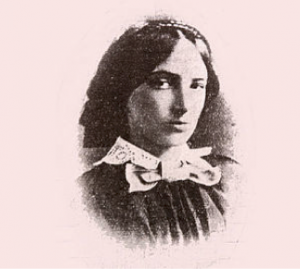
Soledad Acosta de Samper is one of the greatest figures in 19th-century Latin American literature. She was a prolific writer, historian, traveler, and tireless cultural promoter. She dedicated herself to improving American societies through female education, the cornerstone of which was knowledge of history and local customs.
Like many of her fellow authors, she belonged to a notable patriotic family: her father, Joaquin Acosta, was a military man, hero, and historian. Years later, she married and raised a family with José María Samper, one of Colombia’s most prominent politicians and diplomats.
Her mother, Caroline Kemble Rou, was born in Jamaica and married José Acosta in New York. This foreign influence led Soledad to learn multiple languages and about varied cultures from a very young age. Acosta first attended school in Bogotá and later studied in Canada, England, and Paris.
She married José María Samper in 1855. The couple lived in Europe from 1858 to 1862. Starting in 1859, Soledad began contributing to the American and European press. Her first works appeared under the pseudonym “Andina”, but throughout her career she would use others such as “Aldebarán”, “Bertilda”, “Renato”, and “Orión”. Acosta mainly published in the Biblioteca de Señoritas and El Mosaico. Her main biographers, critics, and editors, Monserrat Ordóñez, Carolina Alzate and Flor María Rodríguez-Arenas, considered this the first stage of her work. From 1859 to 1863, she produced small contributions for magazines, bibliographies, translations, commentaries, and articles.
This period also included a sojourn in Lima. Acosta and her husband met Alejandro Villota, one of the directors of the newspaper El Comercio, in Paris. Villota subsequently offered José María the position of chief editor. José María and Acosta left for Lima at the end of 1862, a time when the city was a larger, more prosperous, and peaceful place than Bogotá, due to the success of the guano business. After taking over as editor of the newspaper, José María launched its cultural supplement La Revista Americana where Acosta actively collaborated. Twelve issues were published between January 5 and June 20 of 1863. As part of the supplement, Acosta published the Spanish translation of the French text Elements of general hygiene by Dr. Luis Crubeilhier, as well as the bibliography section. She also took over the direction of “Revista femenina”, which she introduced in this way: “If on all English steamships, as on European railways, there is always a lounge or a carriage or compartment reserved for ladies where no man can enter, why shouldn’t there be in a newspaper such as this Magazine a place where ladies can talk face-to-face, without risk of being interrupted by the uglier sex? (45-46)”.
That said, the opening of this literary space did not restrict topics to traditional feminine themes like fashion and chronicles from social salons, but instead opened the door to other areas such as art, reading, and science.
The couple then returned to Bogotá in mid-1863. This marked the beginning of the second stage of Acosta’s work, in which romantic fiction would predominate. In this period, American settings blend with European memories together, with an intimate tone showing how female protagonists were subjected to the male laws that governed societies.
These novels and stories continued to be published in the Colombian press. Years later, a compilation volume appeared in Belgium titled Novelas y cuadros de la vida sudamericana in 1869. It included: Dolores (1867), published the same year as María by Jorge Isaacs, both of which address the topic of sick women; Teresa la limeña (1868), inspired by Acosta’s experience in Lima; El corazón de la mujer; La perla del Valle; Ilusión y realidad; Luz y sombra; Tipos sociales; and Un crimen.
This volume included a prologue by José María Samper, who, in a clear position of patronage, wrote: “For my part, I wanted my wife to add her efforts and always humble contributions to the common work of literature that our young republic is forming, in order to maintain, in some small way, the tradition of her father’s patriotism…” (4, Novellas y cuadros, 2006). Acosta was raised and came of age inside the confines of a disciplined and domestic upbringing that explains her submissive stance. However, as the years passed, her pen would reveal her true talent, along with her independence.
In 1872, two of Acosta’s four daughters died in an epidemic, and just three years later, her husband was imprisoned. These tragic events would darken Acosta’s life.
It was in this period that she produced her well recieved novel, called Una holandesa en América.
In 1878, the third stage of Acosta’s literary career began with the founding and direction of the magazine La Mujer (1878-1881) which would be followed by others such as, La Familia (1884-1885), El Domingo de la Familia Cristiana (1889-1890), El Domingo (1898-1899), and Lecturas para el Hogar (1905-1906). She was widowed in 1888, and from this year forward, she was accompanied only by her youngest daughter. Her creative work was incessant, focusing primarily on historical research. She wrote Biografías de hombres ilustres o notables relativas a la época del descubrimiento, conquista y colonización de la parte de América denominada actualmente E.E.U.U. de Colombia (1883), Los piratas en Cartagena: crónicas histórico novelescas (1886), La mujer en la sociedad moderna (1895) which she justified with the question: “If a good example is the most powerful weapon to promote civilization, why should Hispanic American women, whose education has been so neglected, not be presented with excellent examples of active, hardworking women who have made their own way…?” (IX).
The turn of the century arrived with an abundance of projects: Biografía del general Joaquín Acosta: prócer de la independencia, historiador, geógrafo, hombre científico y filántropo (1901), Aventuras de un español entre los indios de las Antillas (1905), Catecismo de historia de Colombia (1908), Biblioteca histórica (1909), and Biografía del general Antonio Nariño (1910).
Despite the restrictions that this time period imposed on literary women, it is undeniable that Acosta managed to gain access to the intellectual circles of her country and of the Americas. She was named a delegate from Colombia to the Congress of Americanists in La Rábida (Spain) and in 1892, to the commemorative congresses of the IV Anniversary of Colombus’ arrival in America. Acosta became an honorary member of the Asociación de Escritores y Artistas de Madrid, the Academia Nacional de la Historia de Caracas, the Sociedad de Historia Nacional de Bogotá, and, posthumously, she was recognized as a member of the Academia Colombiana de la Historia.
Mónica Cárdenas MorenoUniversité de Bertagne-Sud/Ameriber http://labellalimena.blogspot.com/

