


Teresa González del Real de Fanning

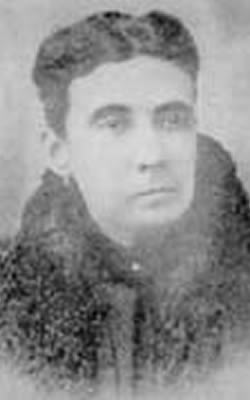 Translated by Brendan O’Rourke
The educator, writer, and journalist Teresa González de Fanning was born on August 12, 1836, in Nepeña, Santa Province, Ancash, Peru. She was the daughter of Jerónimo González, Spanish professor and surgeon, and Josefa del Real y Salas, who lived on the Hacienda San José de la Pampa.
From a young age, González de Fanning was drawn to the classics of her time and received a relatively advanced education. She began writing early, initially under the pseudonyms María de la Luz and Clara del Risco, and later using her own name. She contributed to the leading newspapers in Lima, among others, El Comercio, El Correo del Perú, El Perú Ilustrado, La Alborada, El Semanario del Pacífico, La Patria, and El Nacional.
In 1853, she married Naval Captain Juan Fanning. That same year she began frequenting the literary circles of the period, especially those hosted by Juana Manuela Gorriti, and later those held at the Ateneo de Lima. Her children, Jorge and Emma, died in childhood. The War of the Pacific would prove a dramatic turning point, bringing destruction and death to Peru, and particularly to the city of Lima. Captain Fanning died heroically on January 15, 1881 in the Battle of Miraflores. González de Fanning’s home was ravaged and destroyed during the disastrous war and she was left not only widowed, but also without financial resources. As a result, in March 1881, she decided to open the Escuela de Señoritas, or Liceo Fanning. To this day, she is most remembered for founding this important school.
The Liceo Fanning was a school for young women, the first of its kind at the time. It allowed González de Fanning to put into practice her belief that women should receive a well-rounded education, not just preparation for marriage. Her educational philosophy was visionary for the period: she insisted that only an education grounded in moral values could form responsible and civic-minded individuals, a belief she articulated in her 1898 essay “La educación femenina” [1]:
“We take it as certain—and no one will presume to contradict us—that for an education to be good, it must be grounded in the principles of a solid moral foundation that instills in the student a constant commitment to the fulfillment of duty. Instruction should aim not only at the pursuit of truth and the acquisition of useful knowledge, but also at ensuring that such knowledge can be applied within the social environment in which one lives, thereby providing the means necessary to resolve the problems that arise in practical life.” (3)
In this pedagogical article, González de Fanning expressed her support for the creation of secular schools. These schools would steer girls away from traditional education oriented primarily toward perpetuating gender subordination as practiced in convents and religious institutions of the period. As Jorge Basadre Grohmann noted, the work of González de Fanning as an educator stands out because she advocated for an education that would form rational and thoughtful citizens, capable of contributing to the individual, social, and civic good (3391).
Women writers of the nineteenth century widely recognized and valued González de Fanning’s work as an educator and writer. Clorinda Matto de Turner, in her essay “Las obreras del pensamiento de América del Sud,” illustrated that sentiment:
“Teresa González, widow of Captain Fanning, who died gloriously in the war against Chile, devoted herself to teaching and literature after witnessing the happiness of her home fade following her husband’s death. She composed a number of verses, many magnificent costumbrista sketches, and several textbooks on geography and history, including a volume titled Lucecitas, whose modest title does not do justice to the merit of the work.”
Former student and later director of the Liceo Fanning, Elvira García y García, claimed that González de Fanning was ahead of her time as an educator and that her pamphlet “La Educación Femenina” established González de Fanning as the first true Peruvian educator (La mujer peruana a través de los siglos 32). González de Fanning participated in the First International Women’s Congress of the Argentine Republic in 1910, presenting a talk titled “Educación doméstica y social de la mujer” (Domestic and Social Education of Women). In this address, she zealously called for a radical reform of women’s education in Latin America.
Her most notable literary contributions are four romantic works: the short novel Ambición y abnegación (1886), the novel Regina (1886), which received an award from the Ateneo de Lima, the short novel Indómita (1904), and the historical novel Roque Moreno (1904). This last novel was originally published in installments in a legal journal in Buenos Aires, Argentina. In it, González de Fanning addressed historical themes and examined class conflicts through the lens of social memory in the early period of Peruvian independence. The author underscored the treatment of ethnic and racial difference: she expressed an unmistakable rejection of the Spanish conquest and provided an evaluation of race and social class through certain characters in her writing, thus expressing her assessment as shaped by the stereotypes of the period.
González de Fanning also published the book Lucecitas in 1893. In it, she brought together a series of narratives, short stories, and essays previously published in various newspapers throughout Lima, with a controversial preface by Spanish author Emilia Pardo Bazán. Pardo Bazán argued that the book did not need “patrons or prologues”: “In the book that I hold in my hands, which certainly requires neither patrons nor prologues, Mrs. Fanning brings together works of various kinds: short stories, novellas, traditions, pedagogical studies, and costumbrista articles” (Lucecitas VII).
González de Fanning, educator, writer, and journalist, died on April 7, 1918. In her honor and at the initiative of the Ministry of Education, the educational institution Teresa González de Fanning was established in 1952 and is today still considered a flagship institution.
Fanny Arango-Keeth
Mansfield University of Pennsylvania
